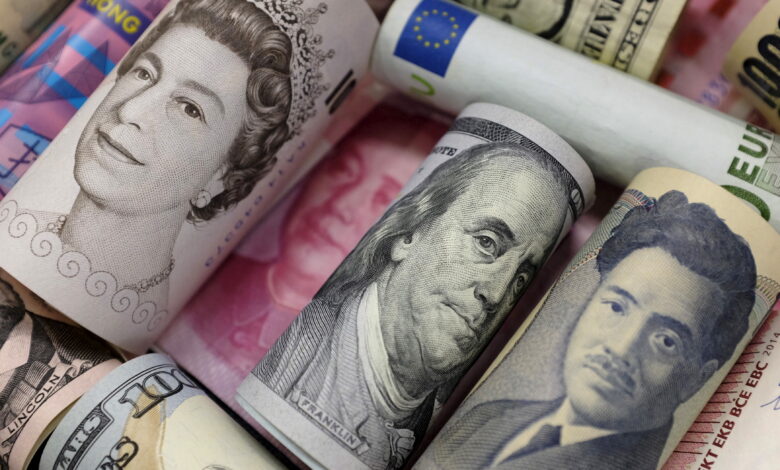


The Egyptian pound has suffered the steepest drop against the US dollar among Africa’s major economies over the past decade. This drop underscores how repeated currency devaluations and sweeping economic reforms have reshaped the financial landscape in the continent’s second biggest economy.
Exchange rate data from African Markets reveals that the Egyptian pound shed 82.7 percent of its value against the greenback between August 2016 and July 2026. This marks the sharpest decline among Africa’s top five economies. Nigeria’s naira followed closely, recording a 77.7 percent depreciation, while Ghana’s cedi lost 66.9 percent. Kenya’s shilling and South Africa’s rand proved far more resilient, shedding just 21.7 percent and 11.2 percent, respectively.
The findings highlight how a decade defined by the International Monetary Fund-backed reforms, foreign exchange shortages, commodity price shocks and changing exchange-rate regimes produced sharply different currency outcomes across the continent’s biggest economies.
Methodology: Measuring currency depreciation
The analysis measures the decline in a currency’s value rather than the increase in its exchange rate.
BusinessDay calculated depreciation using the formula: Currency depreciation (percent) = (new exchange rate − old exchange rate) ÷ new exchange rate × 100
Unlike measuring the percentage increase in an exchange rate—which can exceed 100 percent—this approach captures the actual loss in a currency’s value against the US dollar, making comparisons across countries more meaningful.
Egypt’s devaluations paved the way for recovery
Egypt’s currency recorded the largest decline in the analysis because authorities repeatedly chose large exchange-rate adjustments to correct deep macroeconomic imbalances.
The biggest turning point came in November 2016 when Cairo floated the pound under a $12 billion IMF programme, ending years of an overvalued exchange rate and chronic dollar shortages. Subsequent devaluations between 2022 and 2024, driven by external shocks, rising import costs and renewed IMF reforms, pushed the currency to successive record lows before it stabilised under a more flexible exchange-rate regime.
While the weaker pound surged inflation and import costs, it also laid the foundation for the Arab nation’s recent economic recovery. Foreign exchange shortages eased, reserves improved, portfolio inflows returned, and the country attracted record Foreign Direct Investment of almost $50 billion in 2024, supported by the landmark Ras El Hekma investment agreement with the United Arab Emirates.
The economic backdrop has improved markedly. Data from Egypt’s Central Agency for Public Mobilisation and Statistics (CAPMAS) show inflation slowed to 12 percent in December 2025 from 24 percent in January, easing pressure on households.
At the same time, the economy grew by 5.3 percent year-on-year in the second quarter (October–December) of the 2025/26 fiscal year, matching the previous quarter’s pace and recording its strongest quarterly expansion since the third quarter of the 2021/22 fiscal year, according to the Ministry of Planning and Economic Development.
The country has retained its position as Africa’s largest destination for FDI, while the central bank expects economic growth to exceed five percent over the next two fiscal years.
The Egyptian experience illustrates a difficult trade-off confronting many African economies: large devaluations inflict short-term pain but can restore competitiveness and investor confidence when accompanied by credible reforms.
Nigeria’s reforms triggered a sharp correction
Nigeria ranked second after the naira depreciated 77.7 percent during the period.
Unlike Egypt, where depreciation occurred through multiple IMF-supported adjustments, Nigeria’s biggest correction followed sweeping foreign exchange reforms introduced in 2023. The collapse of multiple exchange-rate windows, efforts by the Central Bank of Nigeria to improve price discovery and the clearance of foreign exchange backlogs resulted in one of Africa’s largest currency adjustments. A further devaluation in January 2024 accelerated the decline.
Although the weaker naira fuelled inflation, raised import costs and squeezed household purchasing power, it also improved liquidity in the foreign exchange market, helped lift Nigeria’s external reserves to nearly $52 billion—the highest level in almost a decade—and supported the country’s return to Africa’s top five destinations for FDI in 2025.
More recently, the currency has stabilised since the second half of last year following sustained reforms, highlighting how markets often reward policy consistency after prolonged adjustment.
Ghana’s turnaround masks deep decade-long losses
Ghana presents one of the most striking contrasts in the analysis.
Although the cedi lost 66.9 percent of its value over the decade, it also emerged as Africa’s best-performing currency in 2025 after IMF-backed reforms restored investor confidence, strengthened reserves and boosted gold export earnings.
But recently, the cedi has reversed much of those gains this year as seasonal dollar demand and external pressures resurfaced. Nevertheless, the currency’s decade-long performance continues to reflect the severe losses suffered during the country’s debt crisis, demonstrating that a strong short-term recovery does not erase years of depreciation.
Kenya and South Africa prove resilience matters
Kenya’s shilling and South Africa’s rand recorded the smallest declines among the currencies analysed, illustrating the benefits of relatively flexible exchange-rate regimes.
Kenya’s shilling depreciated by 21.7 percent despite periods of pressure from rising external debt repayments, a stronger dollar and tighter global financial conditions. Strong diaspora remittances, tourism receipts and prudent monetary management helped prevent the sharp devaluations experienced elsewhere, allowing the currency to recover after its 2023 sell-off.
South Africa’s rand posted the smallest depreciation at 11.2 percent. Although it remains one of the continent’s most actively traded and volatile currencies, the rand has largely adjusted through market forces rather than abrupt policy-driven devaluations. Commodity prices, global investor sentiment and domestic political developments have continued to influence the currency, but cumulative losses remained modest compared with its continental peers.
Different policy choices, different currency outcomes
The decade-long comparison shows that the scale of currency depreciation depended less on geography than on policy choices.
Countries that postponed exchange-rate adjustments or maintained overvalued currencies, such as Egypt and Nigeria, eventually experienced sharper corrections when reforms became unavoidable. Economies operating under more flexible exchange-rate regimes, including Kenya and South Africa, recorded far more moderate long-term losses.
Ghana’s experience offers another lesson: a currency can be Africa’s strongest performer in one year and still rank among the continent’s weakest over a decade if earlier crises inflicted deep losses.
For investors, policymakers and businesses, the findings reinforce that currency stability remains one of the clearest indicators of macroeconomic resilience. As African economies continue to navigate volatile capital flows, geopolitical tensions and shifting commodity markets, the credibility of exchange-rate policy will remain central to attracting investment, containing inflation and sustaining long-term growth.

Bunmi Bailey
Bunmi holds a degree in Economics from the University of Lagos and has over eight years of experience in content writing and journalism.
Her career spans roles as a financial and business journalist at BusinessDay Media and TechCabal, and as Head of Research at SBM Intelligence, an Africa-focused market intelligence and strategic consulting firm.
She also served as Editor at Finance in Africa, a subsidiary of Businessfront and is currently Assistant Editor, Finance (Africa), at BusinessDay.